Dear Smart Investor,
The NASDAQ entered into bear market territory two weeks ago.
On Friday, the tech-heavy index closed at 21% below its 52-week high.
Unlike 2020’s bear market, the current decline has been gradual, fanned by fears over inflation, interest rates and the repercussions of the Russia-Ukraine war.
In the near term, the lack of investment returns can be discouraging.
Especially when you don’t know when the stock market will hit bottom.
A punch in the gut
The current bear market reminds me of a stock that I have been following since 2006.
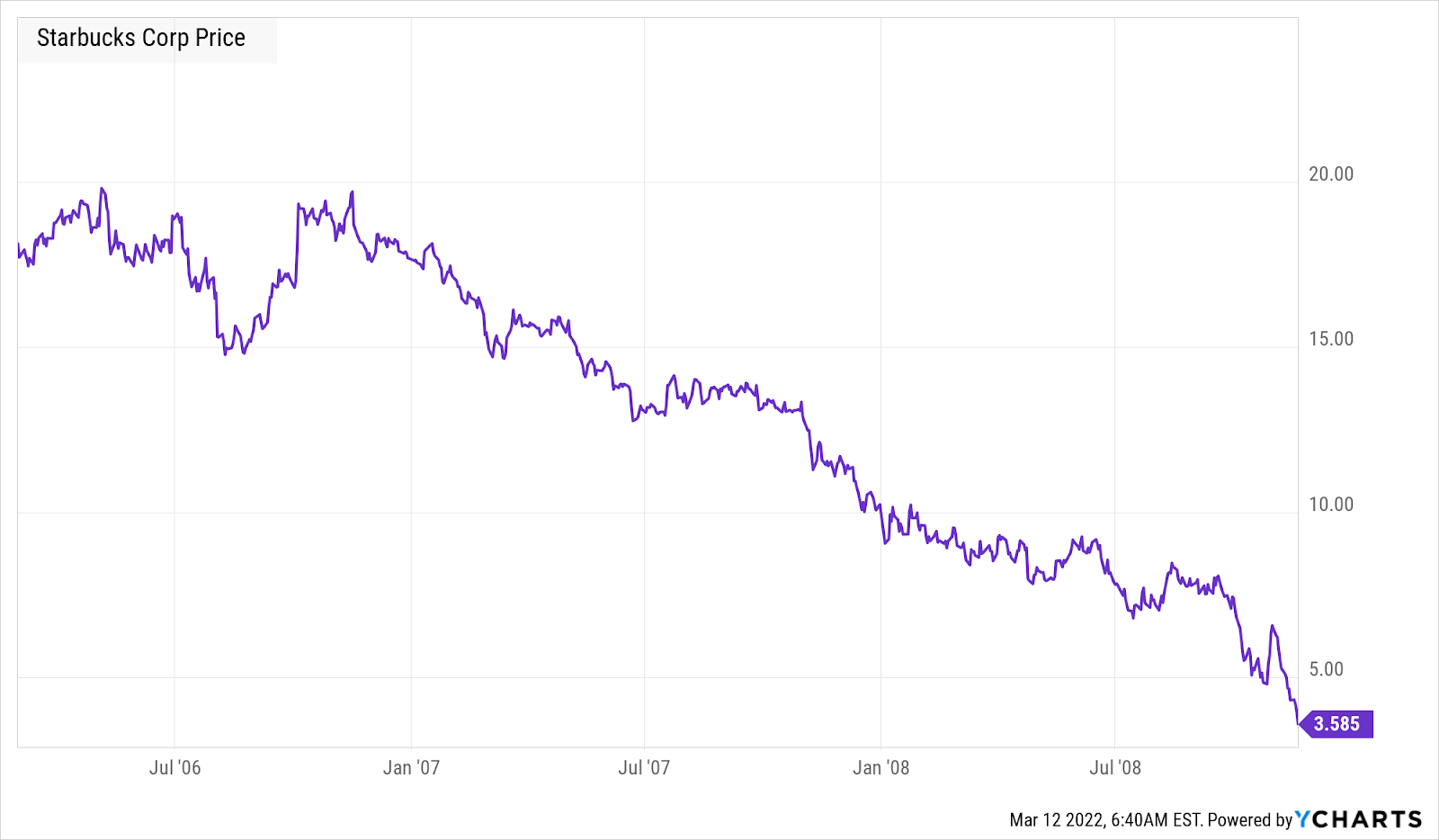
Shares of the company almost touched US$20 in late 2006 before being cut in half over the next 15 months or so.
Source: YCharts
When a stock price falls from US$20 to US$10, your inclination, as an investor, would be to consider these shares as cheap.
However, if you bought this stock, you would be in for a rude shock.
The share price would continue to fall from US$10 to under US$4 over the next 12 months or so, shrinking your investment by 60%.
At that point, your investment returns would have been dreadful.
Surely, buying shares at US$10 was a mistake … right?
Winners disguised as mistakes
Whether you have made an investment mistake or not will be revealed over time.
Fast forward to today …
If you were still holding the shares at US$10, you’ll be surprised at the result.
You see, the stock I was talking about is Starbucks (NASDAQ: SBUX).
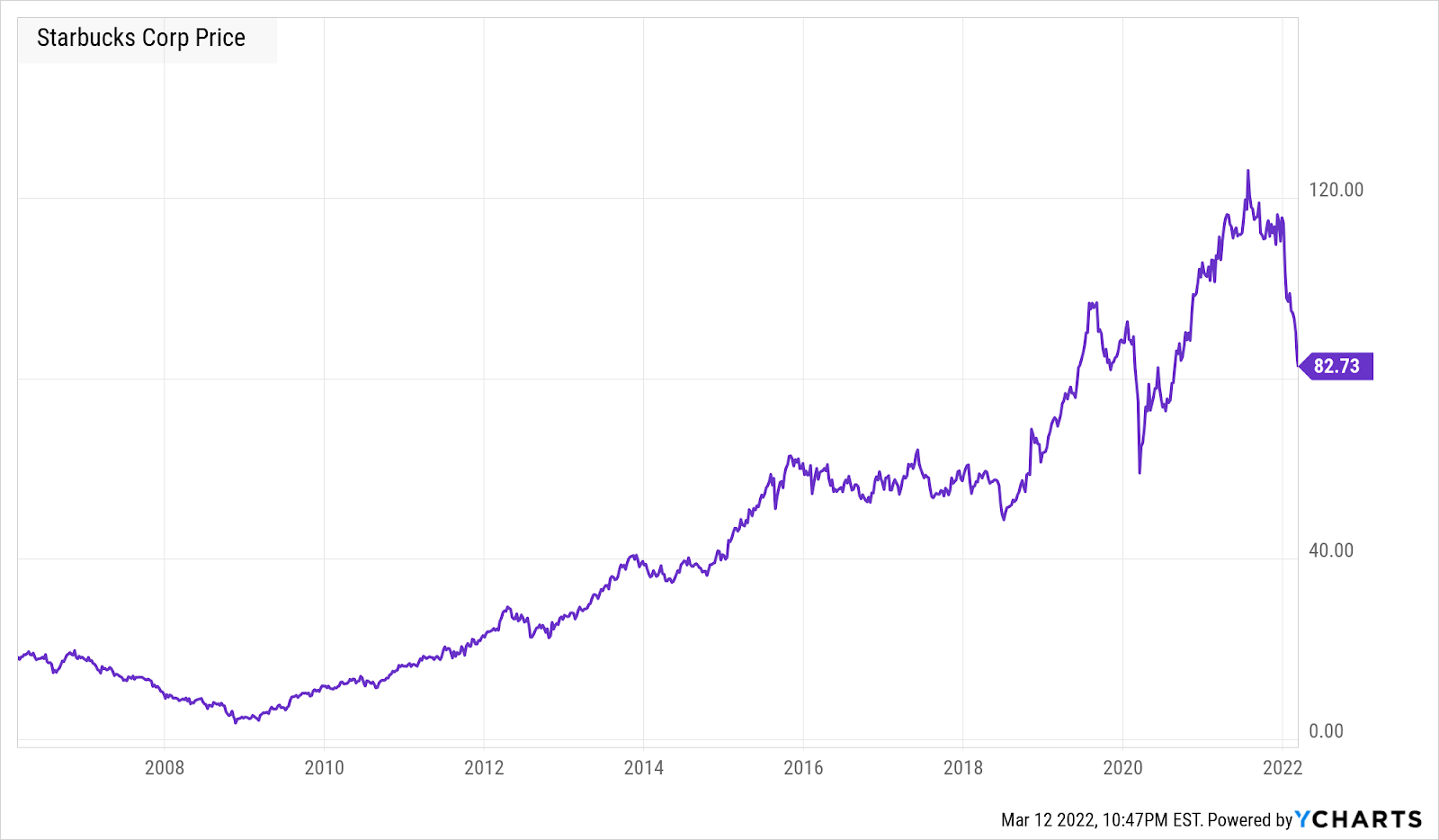
Today, shares of the global coffee chain are trading at over US$82 …
… and that’s after a sizable decline since the start of this year.
Source: YCharts
As it turns out, whether you bought at US$10 or US$4 in 2008, you would still be sitting on good profits.
What’s more, Starbucks currently pays annualised dividends of US$1.96 per share.
In other words, your US$10 shares are giving you a near 20% yield on cost.
From a mistake to a winner
There are good reasons why Starbucks shares were able to recover from their 2008 lows.
For starters, the global coffee chain was far from a broken business.
Back in fiscal 2008, the business had US$10.3 billion in revenue and generated over US$270 million in free cash flow.

Source: TIKR
Today, the coffee chain boasts over US$28.5 billion in sales and generated more than US$4.46 billion in free cash flow over the past 12 months.
That’s 1.8 times more sales and over 16 times more free cash flow compared to fiscal 2008.
In short, the performance of Starbucks’ business over the past 13 years has been rewarded with matching investment returns.
Get Smart: The search for the stock market bottom
At some point, the stock market will bottom.
But no one knows exactly when the NASDAQ and its ilk will bottom out.
At the Smart Investor, we don’t try to time the market.
Instead, we believe that the best course of action is to maintain a regular investment schedule, focusing on the best businesses we can find, and buying them.
In the short term, some of our buys may look like mistakes.
But as Starbucks has shown, we stand firm in our belief that if a business performs over the long term, its shares will eventually follow.
In other words, you, as an investor, should stay the course.
It may feel uncomfortable in the short term; but in the long term, you will be glad that you did.
Is now a good time to buy into Singapore REITs? After all, almost 50% of the 44 Singapore REITs were trading close to their 52-week lows in January.
But with the right strategy, mindset and stocks, REITs can still be a powerful source of dividends today and in the years ahead.
And in our upcoming (free) webinar, let us help you further. We’ll show you why REITs remain as one the best retirement assets, where to find resilient REITs that continue to grow and pay dividends, and how to tell if a REIT is worth a spot in your portfolio.
This webinar is free and spots are limited, so register now and save a seat for yourself! Click HERE to register for free now!
Don’t forget to follow us on Facebook and Telegram for the latest investing news and analyses!
Disclosure: Chin Hui Leong owns shares of Starbucks.