When a company makes a clear commitment to its shareholders, the next earnings release is where the rubber meets the road.
In the last week of October, three SGX-listed companies will show whether they are keeping their word.
Key Metrics Comparison
| Metric | iFAST Corporation Ltd | CapitaLand India Trust | CapitaLand Ascott Trust |
| Stock Ticker | SGX: AIY | SGX: CY6U | SGX: HMN |
| Reporting Date | 26 October 2026 | 28 October 2026 | 27 October 2026 |
| 1H2026 Revenue / Income | S$316.5 million(+39.3%) | S$137.6 million(-8.0% in SGD / +3.0% in INR) | Total Distribution: S$97.5 million(+1.0%) |
| 1H2026 Profit / NPI | Net Profit: S$57.9 million (+40.7%) | NPI: S$107.5 million(-5.0% in SGD / +6.0% in INR) | Core Distribution: S$83.3 million (-9.0%) |
| Payout Metric (1H2026 vs 1H2025) | Interim Dividend: S$0.03 per share (+50.0%) | DPU: S$0.04 (+1.0%) | DPS: S$0.0253 (Flat) |
iFAST Corporation: Can the dividend keep up with the new guidance?
Wealth management fintech iFAST Corporation (SGX: AIY) reports on 26 October 2026.
The group runs a wealth management platform across Asia and the UK, and owns a UK digital bank.
The business is growing fast.
For the first half of 2026 (1H2026), revenue rose 39.3% year on year (YoY) to S$316.5 million, while net profit attributable to owners rose 40.7% to S$57.9 million.
Importantly, recurring revenue accounted for 90.2% of non-banking net revenue, providing a stable foundation for distribution planning.
iFAST declared a second interim dividend of S$0.03 per share, up 50% from S$0.02 a year ago, while raising full-year dividend guidance to S$0.12 or higher.
The main focus for investors will be whether upcoming declarations stay firmly on track to clear that higher hurdle.
The other number to track is assets under administration (AUA).
AUA reached a record S$36.13 billion as at 30 June 2026, up 32.8% YoY, as net inflows rose 15.2% YoY to S$2.56 billion in 1H2026.
To meet its target of S$100 billion in AUA by 2030, iFAST needs to compound AUA by roughly 25% annually from mid-2026 levels.
What about free cash flow?
It fell to S$140.9 million from S$435.8 million a year ago due to banking deposit movements and product financing receivables.
Here’s the thing: those are banking flows.
So free cash flow gives a noisy read on dividend capacity here.
iFAST ended June with S$384.7 million in net cash.
CapitaLand India Trust: Will data centre income outpace the rupee?
CapitaLand India Trust (SGX: CY6U), or CLINT, reports on 28 October 2026.
The business trust owns IT parks, industrial facilities, a logistics park and data centres across five Indian cities.
In Singapore dollars, total property income fell 8% YoY to S$137.6 million, and net property income (NPI) slid 5% to S$107.5 million.
In rupees, both grew, by 3% and 6% respectively.
Why the difference?
The average exchange rate moved from 64.5 to 72.1 rupees per Singapore dollar.
In other words, each Singapore dollar bought about 12% more rupees, so CLINT’s rupee income shrank once converted.
Distribution per unit (DPU) still rose 1% YoY to S$0.04.
Committed occupancy held at 91%, and rental reversion reached 24% on a trailing 12-month basis.
The one to watch is CapitaLand DC Navi Mumbai Tower 1.
CLINT handed the whole tower over to a hyperscaler in July 2026, and full income started flowing in August 2026.
CLINT also drew down an onshore INR 5.5 billion (about S$74 million) term loan, which is expected to lift DPU by about 1.6% DPU.
Gearing stood at 38.0%, and the average cost of debt was 5.6%.
Keep an eye on how CLINT funds its 6.4 million sq ft forward purchase pipeline.
CapitaLand Ascott Trust: When will the sale proceeds go back to work?
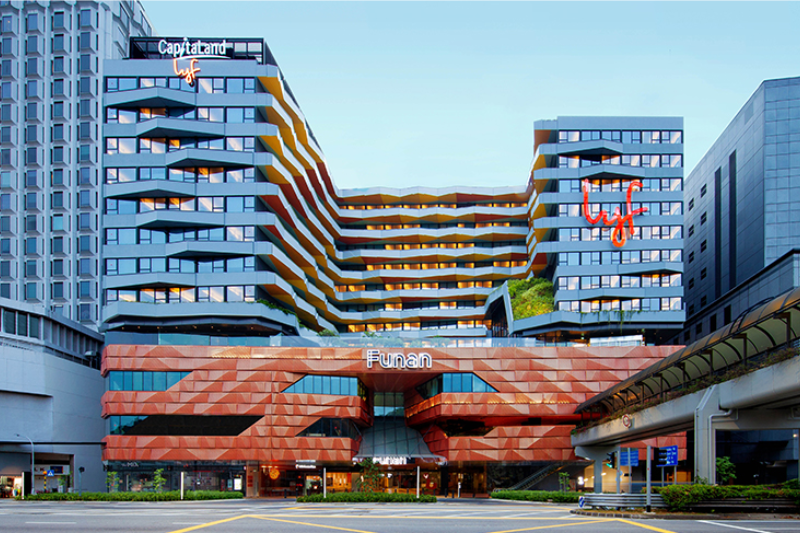
CapitaLand Ascott Trust (SGX: HMN), or CLAS, reports on 27 October 2026.
It is the largest lodging trust in Asia Pacific, with 106 properties across 16 countries.
On paper, CLAS had a steady half.
Distribution per stapled security (DPS) held at S$0.0253, while total distribution rose 1% YoY to S$97.5 million.
The core numbers are softer.
Core distribution income fell 9% YoY to S$83.3 million, while higher non-periodic gains lifted income available for distribution by 11%.
For context, much of that decline looks temporary.
CLAS has yet to reinvest the money from selling Citadines Central Shinjuku Tokyo.
Asset enhancement initiatives (AEIs) at The Cavendish London and Sotetsu Grand Fresa Osaka-Namba have taken income offline.
Currency movements and one-off tax adjustments in China and Australia added to the drag.
On a same-store basis, distribution income fell just 1%.
CLAS also sold The Robertson House by The Crest Collection for S$360 million, a 4% premium to valuation, and made a gain of S$38.1 million.
So far, it has bought three Japanese rental housing properties for S$38.3 million at a 4.1% net operating income yield.
That spend is only about a tenth of The Robertson House sale price.
Management has promised stable distributions, funded by divestment gains, until the AEIs are done and CLAS puts the money back to work.
Look for progress on both in the October update.
Gearing improved to 37.7% from 38.9% quarter on quarter, and its cost of borrowing stood at 2.8%.
Get Smart: Where does the payout come from?
Before the results land, ask yourself where each dollar of dividend comes from.
A payout funded by recurring income can grow with the business.
For iFAST, the test is whether earnings keep up with its higher dividend guidance.
A payout bridged by one-off gains is different.
That bridge only lasts as long as the gains do.
CLAS has told you what ends it: finished AEIs and reinvested proceeds. Track both.
When the numbers arrive, start with where the payout comes from.
The headline figure can wait.
You’ve probably shopped at their malls, banked with them, or bought their products this month. These 6 SGX companies have paid dividends for 20 straight years, GFC and COVID included. Our FREE report shows you which ones, and what has kept their dividends going for 20 years and more. Grab your copy here.
Follow us on Facebook, Instagram, Telegram and YouTube for the latest investing news and analyses!
Disclosure: The Smart Investor owns shares of iFAST.