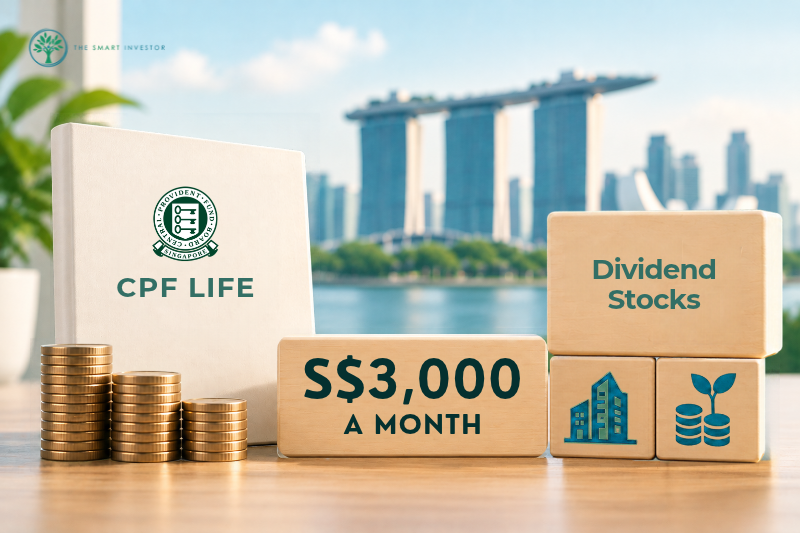
You want S$3,000 a month in retirement.
You start doing the maths.
At a 4% dividend yield, you’ll need S$900,000 invested to generate that income.
That’s when retirement starts to feel rather expensive.
But what if you don’t actually need S$900,000?
What if part of your retirement income is already taken care of?
That’s where CPF LIFE comes in.
By combining CPF LIFE payouts with dividends from Singapore stocks and real estate investment trusts (REITs), you could reduce the amount your investment portfolio needs to generate.
And as we’ll see, the difference could be worth hundreds of thousands of dollars.
How Much Can CPF LIFE Pay You Every Month?
CPF LIFE provides monthly payouts for as long as you live, helping Singaporeans manage the risk of outliving their retirement savings.
How much CPF LIFE pays you depends on your Retirement Account savings, the plan you choose and when you start receiving payouts.
CPF has three retirement sum reference levels: Basic Retirement Sum (BRS), Full Retirement Sum (FRS) and Enhanced Retirement Sum (ERS).
For someone turning 55 in 2026, CPF Board provides the following illustrations.
| CPF Retirement Sum | Savings at Age 55 | Estimated Monthly Payout from Age 65 |
|---|---|---|
| Basic Retirement Sum (BRS) | S$110,200 | S$950 |
| Full Retirement Sum (FRS) | S$220,400 | S$1,780 |
| Enhanced Retirement Sum (ERS) | S$440,800 | S$3,440 |
Source: CPF Board . Estimates are for a male member turning 55 in 2026, under the CPF LIFE Standard Plan, with savings earning CPF interest until payouts begin at age 65. Actual payouts may vary.
These retirement sums are reference points, not mandatory savings amounts everyone must accumulate. The Basic Retirement Sum is intended to cover basic living needs excluding rent.
Here’s what matters from an investor’s perspective: the more retirement income CPF LIFE provides, the less your investment portfolio needs to generate.
That can significantly change how much capital you need.
How Much Dividend Income Do You Need for Retirement?
Let’s return to your S$3,000 monthly retirement income target.
Without any other income, generating S$36,000 annually from dividends at an assumed 4% yield would require S$900,000 in investment capital.
But suppose you’re receiving S$1,780 a month from CPF LIFE.
Suddenly, your dividend portfolio only needs to generate another S$1,220 monthly or S$14,640 annually.
At a 4% dividend yield, that translates into S$366,000 in investment capital.
That’s S$534,000 less than the original S$900,000 target.
Here’s how the numbers change depending on your CPF LIFE payout.
| Monthly CPF LIFE Payout | Additional Monthly Income Needed | Investment Capital Needed at 4% Yield |
|---|---|---|
| S$950 | S$2,050 | S$615,000 |
| S$1,780 | S$1,220 | S$366,000 |
| S$3,440 | S$0 | S$0 |
Illustrative calculations based on a S$3,000 monthly retirement income target and an assumed 4% annual dividend yield. Dividend income is not guaranteed. Figures exclude inflation, investment fees and applicable taxes.
Of course, the amount you need to invest also depends on the dividend yield your portfolio generates.
| Assumed Annual Dividend Yield | Investment Capital Needed |
|---|---|
| 3% | S$488,000 |
| 4% | S$366,000 |
| 5% | S$292,800 |
| 6% | S$244,000 |
Illustrative calculations based on S$14,640 in annual dividend income, equivalent to S$1,220 a month. Dividend yields are assumed and not guaranteed. Figures exclude inflation, investment fees and applicable taxes.
These calculations assume the stated dividend yield is maintained, which is not guaranteed.
Calculate Your Own Retirement Income Gap
Your retirement income target and CPF LIFE payout may differ from these illustrations.
Use our calculator below to adjust your desired monthly income, estimated CPF LIFE payout and assumed dividend yield. You’ll see how much additional investment capital you may need.
Your Retirement Income Calculator
See how CPF LIFE and dividend investments could work together towards your monthly retirement income target.
Loading calculator… If this message does not disappear, JavaScript is not running on this page and the figures below will not update.
- CPF LIFE
- Additional dividend income needed
—
This calculator is for educational illustration only. The 2026 CPF LIFE estimates apply to a male member turning 55 in 2026 under the CPF LIFE Standard Plan, with payouts beginning at age 65. Actual payouts may differ. Dividend yields are assumed, not guaranteed, and investment values may fluctuate. Figures are expressed in nominal dollars. Inflation, investment fees and applicable taxes are not taken into account.
CPF LIFE vs Dividend Stocks: What’s the Difference?
CPF LIFE and dividend stocks can complement each other, but they serve different purposes.
CPF LIFE provides lifelong monthly payouts, while dividend stocks offer the potential for additional income and capital appreciation.
There are important differences in how much flexibility and certainty each provides.
| Consideration | CPF LIFE | Dividend Stocks |
|---|---|---|
| Income | Lifelong monthly payouts | Dividends can rise, fall or stop |
| Investment Value | Not exposed to share-price fluctuations | Share prices fluctuate |
| Access to Capital | Subject to CPF withdrawal rules | Shares can generally be sold |
| Growth Potential | Depends on CPF savings and chosen payout plan | Potential dividend growth and capital gains |
| Main Risk | Purchasing-power risk and limits on accessing capital | Market losses and dividend cuts |
For instance, CPF LIFE could help cover essential household expenses, while dividend income provides additional flexibility for discretionary spending.
The aim isn’t necessarily to choose one over the other, but to understand what each can contribute to your retirement income plan.
Should You Put More Money Into CPF or Dividend Stocks?
This is where retirement income planning becomes more personal.
Additional CPF retirement savings can increase your eventual lifelong payouts. CPF LIFE also offers an Escalating Plan, which starts with lower payouts that increase over time.
However, CPF savings are subject to withdrawal restrictions.
Dividend investments offer greater flexibility because you can generally sell your shares when you need access to capital, although doing so during a downturn could mean accepting losses.
Consider two investors targeting S$3,000 monthly.
One might prefer to build up CPF savings for higher lifelong payouts. Another might prioritise an accessible investment portfolio, accepting the possibility of fluctuating dividends and share prices.
The appropriate balance depends on your existing CPF savings, retirement timeline, liquidity needs and willingness to take investment risks.
Don’t Let a High Dividend Yield Fool You
Remember our earlier calculation?
To generate S$14,640 annually, you would need S$366,000 invested at a 4% dividend yield.
At 6%, you would need just S$244,000.
That’s S$122,000 less investment capital.
Tempting, isn’t it?
But there’s a reason investors shouldn’t chase the highest dividend yield.
A yield can rise simply because a company’s share price has fallen. If earnings weaken or debt becomes harder to manage, that attractive yield may not last.
For investors building retirement income from Singapore dividend stocks and REITs, three questions matter:
- Can the business sustain its dividends? Examine earnings, cash flow, debt and payout commitments.
- Is your income diversified? Relying heavily on a few banks or REITs could expose your portfolio to sector-specific problems.
- Can you manage uneven payouts? Dividends may arrive quarterly or half-yearly, so cash reserves can help cover monthly spending.
A sustainable 4% yield may ultimately serve your retirement needs better than a 6% yield that gets cut, although neither outcome is guaranteed.
How to Build Your S$3,000 Monthly Retirement Income Plan
Start by estimating your monthly retirement expenses, then check how much CPF LIFE could provide using CPF Board’s Retirement Payout Planner.
Next, calculate your remaining income gap and assess whether your investment portfolio can realistically generate the difference.
Finally, consider whether your investments are sufficiently diversified and whether their income can remain sustainable through different market conditions.
Reaching S$3,000 a month in retirement isn’t necessarily about accumulating a S$900,000 dividend portfolio.
Depending on your CPF LIFE payouts, the amount your investments need to generate could be considerably smaller.
The challenge is building that additional income without taking unnecessary risks simply to chase higher yields.
A good retirement plan isn’t about making every dollar work harder. It’s about making sure each source of income has a job to do.
You’ve probably shopped at their malls, banked with them, or bought their products this month. These 6 SGX companies have paid dividends for 20 straight years, GFC and COVID included. Our FREE report shows you which ones, and what has kept their dividends going for 20 years and more. Grab your copy here.
Follow us on Facebook, Instagram, Telegram and YouTube for the latest investing news and analyses!
Disclaimer: Figures are for educational illustration and expressed in nominal dollars. Inflation, investment fees and applicable taxes are excluded. CPF LIFE payouts are estimates; dividend yields and investment returns are not guaranteed.