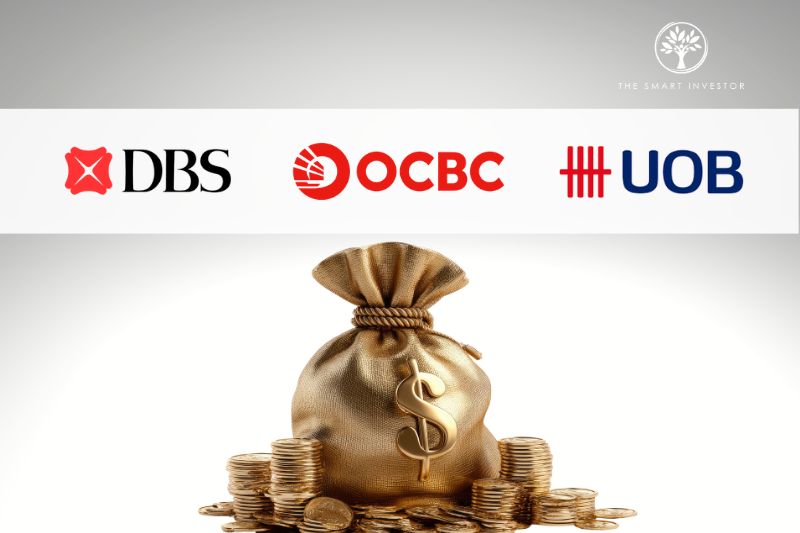
DBS Group Holdings (SGX: D05), Oversea-Chinese Banking Corporation (SGX: O39), or OCBC, and United Overseas Bank (SGX: U11), or UOB, have been favourites among income investors.
Over the past decade, the three banks have rewarded their shareholders through both rising share prices and dividends.
But looking at the share price alone misses the whole picture.
This article looks at which one would have made you the most money if you had invested S$10,000 in each bank 10 years ago.
The S$10,000 Test
For a fair comparison, we assume S$10,000 was invested in each bank on 23 September 2016 and held until 23 September 2026.
We include both share-price appreciation and all dividends received over the period.
DBS’s 2024 one-for-10 bonus issue is also reflected in the share count.
Brokerage fees and taxes are excluded.
In simple terms: Total return = capital gains + dividends received
| DBS | OCBC | UOB | |
| Initial investment (S$) | 10,000 | 10,000 | 10,000 |
| Starting share price – 23 September 2016 (S$) | 13.84 | 8.55 | 18.85 |
| Shares purchased | 723 / 795* | 1,169 | 530 |
| Current share price – 23 September 2026 (S$) | 77.69 | 31.65 | 42.84 |
| Current share value (S$) | 56,134 | 36,999 | 22,727 |
| Cumulative dividends (S$) | 13,030 | 7,397 | 7,219 |
| Total value (S$) | 69,164 | 44,396 | 29,946 |
| Total return (%) | 592 | 344 | 199 |
| Annualised return (%) | 21.3 | 16.1 | 11.6 |
*DBS share count increased following its 1-for-10 bonus issue in 2024
The winner is clear.
A S$10,000 investment in DBS would have grown to roughly S$69,200, including dividends.
The same amount invested in OCBC would be worth about S$44,400, while UOB would have grown to around S$29,900.
What Drove the Difference?
DBS delivered the strongest earnings growth, with net profit rising from S$4.2 billion in 2016 to S$10.9 billion in 2025, while ROE improved from 10.1% to 16.2%.
OCBC’s net profit more than doubled from S$3.5 billion to S$7.4 billion over the same period, supported by its banking, wealth management and insurance businesses.
UOB’s net profit rose from S$3.1 billion in 2016 to S$4.7 billion in 2025, an increase of 52%. Its slower earnings growth relative to DBS and OCBC partly explains its more modest share-price appreciation over the decade.
The Dividend Difference
Dividends were also an important part of the return for all three banks.
| DBS | OCBC | UOB | |
| Capital gain (S$) | 46,134 | 26,999 | 12,727 |
| Cumulative dividends (S$) | 13,030 | 7,397 | 7,219 |
| Dividend contribution to total gain (%) | 22.0 | 21.5 | 36.2 |
| Total gain (S$) | 59,164 | 34,396 | 19,946 |
DBS produced the most dividend income in dollar terms, but its large capital gains meant dividends accounted for around one-fifth of its overall gain.
For UOB, dividends contributed more than one-third of the total gain.
This shows why looking only at a share price chart can understate the returns generated by mature dividend stocks.
What If You Reinvested Every Dividend?
Taking dividends as cash provides income today, but reinvesting gives investors more investment opportunities.
With reinvestment, each dividend would buy additional shares, which then generate their own dividends.
Over time, this creates a compounding effect and increases the final portfolio value.
The impact is particularly powerful when dividend growth is paired with rising share prices since those additional shares will now also participate in future capital gains.
The Pandemic Put Bank Dividends to the Test
COVID-19 also showed that the banks’ dividends do not depend on earnings alone.
During the pandemic back in 2020, the Monetary Authority of Singapore (MAS) capped Singapore banks’ dividends at 60% of their 2019 levels to preserve capital.
As a result, the three banks reduced their payouts despite remaining profitable.
The restrictions were lifted in 2021 and dividends subsequently recovered – a reason why historical dividend growth should not simply be extrapolated in a straight line.
Dividend Growth Matters Too
For long-term shareholders, growing dividends can increase the income earned on the original investment.
This is known as the yield on cost.
Someone who bought the shares at much lower prices in 2016 could now be receiving a much higher yield on their original S$10,000 than the dividend yield we see today.
DBS gets the spotlight here as its dividends per share has increased substantially over the decade together with stronger earnings and capital generation.
Valuation Matters More Than It Seems
Historical returns are affected by not only how quickly a company grows but also the price investors are willing to pay.
If earnings rise while the market is also willing to assign a higher valuation to those earnings, shareholders benefit from both growth and valuation expansion.
Again, DBS enjoyed both over the 10 years.
However, historical winners do not automatically make the best investment today.
Future returns will still depend on many factors like today’s valuation, earnings growth, and dividend sustainability.
So, Which Bank Actually Made You the Most Money?
| DBS | OCBC | UOB | |
| Current share value (S$) | 56,134 | 36,999 | 22,727 |
| Dividend income (S$) | 13,030 | 7,397 | 7,219 |
| Total return (%) | 592 | 344 | 199 |
| Annualised return (%) | 21.3 | 16.1 | 11.6 |
| Final value of S$10,000 (S$) | 69,164 | 44,396 | 29,945 |
| Dividend share of total gain (%) | 22.0 | 21.5 | 36.2 |
Over this particular 10-year period, DBS was the clear winner.
It produced both the largest capital gain and the most dividend income, turning S$10,000 into almost S$70,000.
OCBC came in second with about S$44,400, while UOB finished third at around S$30,000.
But this comparison also highlights something more important than just identifying the historical winner.
What Can Investors Learn From the Three-Bank Experiment?
The first takeaway is simple: dividends matter.
Share-price gains are only part of the return, and dividends can make a meaningful difference over time.
Starting valuation matters too because paying a lower price gives investors more room for future returns.
Dividend growth can steadily lift income and yield on cost, but it ultimately depends on a strong underlying business.
And lastly, things change, so the bank that looked the most attractive 10 years ago may not offer the best value today.
Get Smart: Total Returns Tell the Real Story
The S$10,000 test shows why investors should look beyond share prices and include dividends when measuring returns.
DBS won the past decade, but today’s valuation and fundamentals will determine the next one.
2008. 2020. 2022. Three of the toughest stretches for Singapore markets in a generation. We found 6 SGX companies that paid a dividend every single year through all three. Our free report reveals the six companies and what allowed them to keep paying when others couldn’t. Click here to download now.
Follow us on Facebook, Instagram, Telegram and YouTube for the latest investing news and analyses!
Disclosure: Si-Fan T. owns shares in DBS and OCBC.