Three Singapore-listed companies outside the blue-chip pack raised their interim dividends by more than 20% this reporting season.
The increases look alike, but what sits behind them does not.
Free cash flow is the foundation of every dividend payout.
That’s where the real story lies.
A board can announce whatever payout it wants, but the cash flow statement reveals what the business can actually afford – and where that cash came from tells you whether it’s a one-off or here to stay.
Can a smaller top line support a bigger dividend?
United Overseas Insurance (SGX: U13), or UOI, underwrites general insurance in Singapore and belongs to the UOB Group.
Insurance revenue fell 8.9% year on year (YoY) in the first half of 2026 (1H2026) to S$52.1 million, down from S$57.2 million a year ago.
Yet, the interim dividend went in the opposite direction, jumping from S$0.07 to S$0.09.
Underwriting explains the discrepancy. Insurance service expenses dropped to S$37.2 million thanks to lower gross incurred claims, while an additional S$4.3 million came off net expenses from reinsurance contracts.
As a result, profit after tax rose 28.4% YoY to S$11.1 million.
That revenue dip requires some context, though.
It isn’t a like-for-like comparison, as UOI attributes the decline to business growth timing that deferred revenue recognition into future periods.
Operationally, cash covers the payout comfortably.
Operating activities generated S$17.7 million against S$1.1 million in fixed asset purchases, leaving free cash flow at roughly S$16.6 million – more than enough to cover the total S$5.5 million dividend payout.
Bank balances and fixed deposits stood at S$76.3 million as at 30 June 2026, with zero borrowings, contingent liabilities, or loan capital reported.
The catch lies in what’s driving these numbers.
A year of lower claims does not become a permanent feature of an insurance business, and management is already warning of claims inflation and tougher market conditions ahead.
Does the order book back the higher payout?
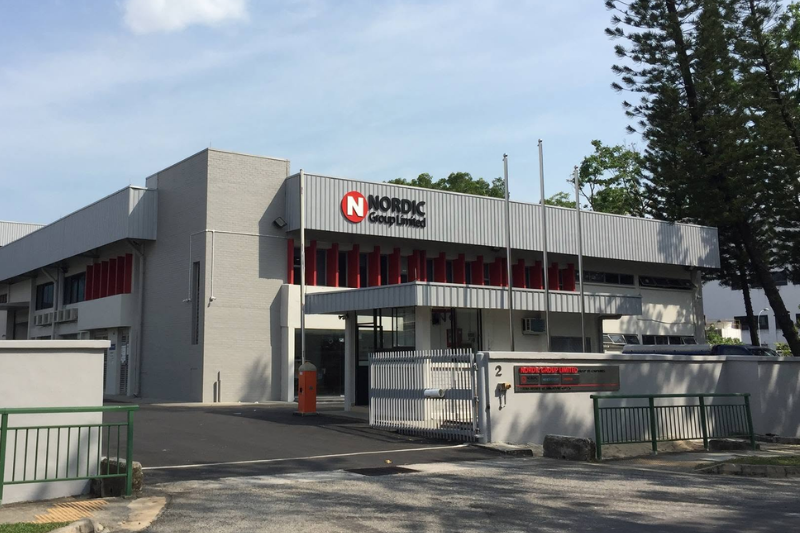
Nordic Group (SGX: MR7) provides engineering solutions through two units, Project Services and Maintenance Services, operating across Singapore, China and Malaysia.
Revenue edged up 3% YoY to S$87.2 million in 1H2026.
Gross margin expanded to 23.6% from 22.6%, driving gross profit up 7% to S$20.6 million.
Meanwhile, net profit attributable to shareholders rose 21% to S$10 million, aided by a 51% drop in finance costs as the company paid down debt.
On the back of these results, the board declared an interim dividend of S$0.010 – up from S$0.008 – payable on 4 September 2026.
Free cash flow, however, headed the other way, falling 28% YoY to S$10.2 million.
That figure needs context; the two halves do not compare directly.
Operating cash flow before working capital changes improved to S$14.9 million.
The decline came from a working capital outflow this period, set against sizeable inflows a year ago.
Higher tax payments and capital expenditure added to it.
The balance sheet reinforces a healthy outlook.
Cash stood at S$46.5 million as of 30 June 2026 against total debt of S$36.23 million (excluding lease liabilities).
That brought its net cash position to S$10.3 million, up from S$4.1 million as at 31 December 2025.
Of the three stocks, Nordic offers the clearest forward visibility, backed by a record order book of S$254.3 million as of 30 June 2026, set for delivery mostly over the next 36 months.
What happens when ERP 2.0 ends?
VICOM (SGX: WJP) delivered the second largest dividend hike of the trio – and the one driven by the least sustainable catalyst.
The testing and inspection group, a subsidiary of ComfortDelGro Corporation (SGX: C52), raised its interim dividend by 27.4% YoY, moving from S$0.031 to S$0.0395.
Revenue grew 6.4% YoY to S$74.3 million, but profit attributable to shareholders surged to S$19.9 million.
The gap between top-line growth and bottom-line expansion is what matters most here: total operating costs fell 1.2% to S$50.3 million, largely because subcontractor fees tied to the ERP 2.0 On-Board Unit project plummeted 44.2%.
Cash generation improved.
Operating cash flow rose 65.1% YoY to S$31.8 million, easily outpacing capital expenditure of S$17.2 million.
Free cash flow reached S$14.7 million – more than double the S$6 million reported a year ago, though that leap looks particularly dramatic due to the low baseline.
The company held S$53 million in cash with no bank borrowings, leaving S$33.3 million in lease liabilities as its only interest-bearing obligations.
While free cash flow covers the dividend hike for now, there isn’t much safety margin left over.
ERP 2.0 installations are tapering off ahead of the project’s scheduled completion in December 2026, leading management to forecast a softer second half.
The cost tailwind fades with the project, and so does part of the revenue.
Capital expenditure tied to the project should ease as well, which pulls in the opposite direction.
Get Smart: What paid for the raise
A dividend hike shows you what a board decided; the cash flow statement shows you what the business can actually sustain.
Before getting excited about a yield increase, figure out where the money came from and whether that funding source has a real future.
A committed order book gives you a defined delivery timeline, and a temporary cost drop comes with a clear expiration date.
Neither guarantees future payouts, but both offer concrete milestones you can track.
A favourable year for insurance claims, on the other hand, is pure luck; you can’t schedule it, and it can reverse without warning.
Keep that lens in mind whenever you evaluate dividend hikes this earnings season.
What if you could collect a steady income from Singapore companies for decades to come? We found one in a near-duopoly with 70%+ market share that’s practically printing money. Our FREE small-cap report uncovers this “hidden monopoly” advantage (plus 4 other dividend powerhouses) that will keep paying no matter what the market does. Click here to grab your copy now.
Follow us on Facebook, Instagram, Telegram and YouTube for the latest investing news and analyses!
Disclosure: Calvina L. does not own shares of any stocks mentioned. Chin Hui Leong contributed to this article and owns shares of UOI and VICOM.