Central Provident Fund (CPF) accounts are the foundation of retirement planning for Singaporeans, offering risk-free returns of 2.5% (Ordinary Account) and 4% (Special Account).
However, these returns are capped.
Several well-run Singapore stocks and REITs offer yields that meaningfully outperform these benchmarks.
Here are five names that currently offer returns that CPF cannot.
Food Empire Holdings — A Cash-Rich Consumer Income Play
Food Empire Holdings (SGX: F03) offers a dividend yield of 4% (at share price of S$2.75).
Backing that yield is steadily rising profits, healthy cash flow, and a net cash balance.
The company maintained a healthy balance sheet with cash of US$135.3 million against total debt of US$91.3 million, leaving it with a net cash position of US$44 million as at 30 June 2025.
Food Empire declared a first-ever interim dividend of S$0.03 in the first half of 2025 (1H2025), signalling business confidence.
Revenue in the third quarter of 2025 (3Q2025) climbed 28.3% year on year (YoY) to US$152.6 million, with Russia recording revenue growth of 48.8%, while Ukraine, Kazakhstan and other CIS markets grew 39.2%.
Free cash flow in 1H2025 swung positive to US$20.5 million, from negative US$15.9 million a year ago, demonstrating better working capital management.
With positive free cash flow and a consumer-staples model, Food Empire’s dividends are well-covered by earnings rather than debt.
Genting Singapore — Tourism Recovery Turning Into Stable Income
Genting Singapore (SGX: G13) offers a trailing dividend yield of about 5.5%, based on its share price of S$0.73, comfortably above CPF’s 2.5% to 4% returns.
The company operates Resorts World Sentosa and holds a market duopoly with a casino license secured through 2036.
Boasting a “fortress balance sheet,” the company reported S$3.3 billion in cash and zero debt as of June 30, 2025.
Sustainability has improved alongside earnings; 3Q2025 net profit rose 19% YoY to S$94.6 million, driven by a 22% jump in gaming revenue.
Crucially, dividends of S$0.04 per share are now funded by robust operating cash flow rather than balance-sheet drawdowns, reflecting a return to more normalised distributions after the pandemic years.
While earnings remain cyclical, Genting’s net-cash position and RWS 2.0 expansion offer a high-yield alternative for investors seeking growth-linked income over the fixed safety of CPF.
Lendlease Global Commercial REIT (LREIT) — Retail & Office Income Above CPF
At S$0.0625, Lendlease Global Commercial REIT (SGX: JYEU) offers a trailing distribution yield of 5.76%, having delivered a full-year FY2025 distribution of S$0.036 per unit.
While payouts dipped due to increased interest costs, portfolio fundamentals have strengthened significantly.
As of the first quarter of fiscal year 2026 (1QFY2026), committed occupancy hit 95.0%, with Singapore retail assets (313@Somerset, Jem, and the newly acquired 70% stake in PLQ Mall) operating at almost full occupancy.
Retail portfolio achieved positive rental reversions of 8.9% in the quarter, while the Sky Complex in Milan saw occupancy jump to 88.5% (from 81.6%).
Portfolio weighted average lease expiry (WALE) remains healthy at 4.8 years by gross rental income, providing good visibility over future cash flows.
Financial risk is notably receding; aggregate gearing is projected to fall from 42.6% to approximately 35% following the divestment of Jem’s office component.
With a lowered cost of debt at 3.09% and 68% of borrowings fixed, the REIT’s stabilized balance sheet and high-traffic assets (313@Somerset and Jem) provide a resilient income platform for 2026.
While refinancing and retail spending risks remain, the REIT’s downside is cushioned by strong occupancy, positive rental reversions, and the financial backing of its sponsor, Lendlease.
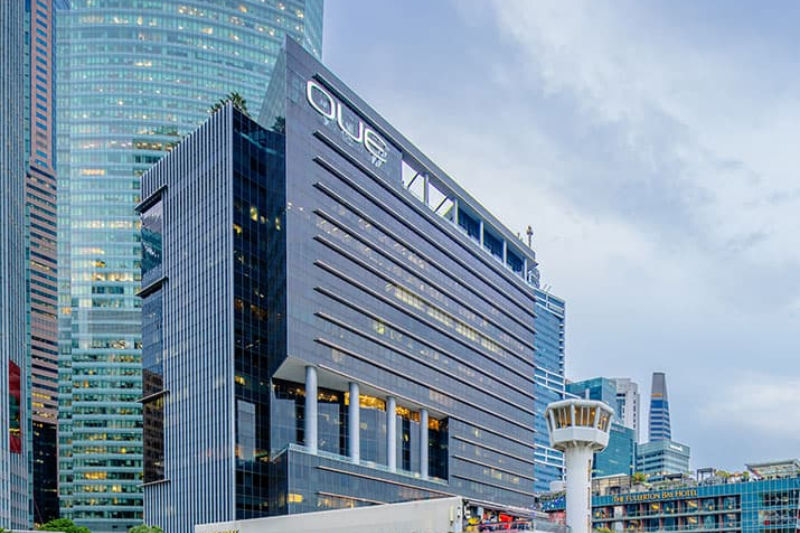
OUE REIT — High Yield From a Prime Commercial Portfolio
At a unit price of S$0.36, OUE REIT’s (SGX: OU8) offers a 5.4% forward yield, significantly outpacing CPF rates.
This distribution is underpinned by prime Singapore assets, with committed occupancy at 95.3% for offices and 97.4% at Mandarin Gallery.
Strong third quarter 2025 (3Q2025) rental reversions of 9.3% (office) and 5.6% (retail) further validate asset quality.
Financial resilience is improving as finance costs dropped 19.7% YoY, lowering the average cost of debt to 4.1%.
With 66.7% of borrowings hedged and only 16% of debt maturing in 2026, near-term refinancing risk is managed.
While sensitive to interest rates and retail spending, OUE REIT’s high occupancy and sponsor backing provide a margin of safety for income-seeking investors.
Suntec REIT — Market-Beaten, Yield-Rich Opportunity
Suntec REIT (SGX: T82U) offers a trailing distribution yield of roughly 4.6% at a unit price of S$1.42.
Momentum is strong: 9M2025 DPU rose 6.7% YoY to S$0.04933, driven by a 12.5% jump in 3Q2025.
Operationally, Singapore assets remain the bedrock, with office and retail occupancy at 98.5% and 99.3%, while Suntec City Mall recorded impressive +15.4% rental reversions.
Although the convention business has recovered, Australian assets face pressure from high incentives, offset by stable UK lease profiles.
Financial risks are receding; aggregate leverage at about 41.0% and around 66% of debt is now fixed or hedged.
With all 2025 refinancing complete and financing costs at 3.62% p.a., near-term funding risk is managed.
Suntec REIT remains a high-yield recovery play for investors comfortable with overseas office exposure in exchange for potential distribution upside.
CPF vs Market: How Much Higher Are These Yields?
While CPF provides a risk-free baseline with zero volatility, high-quality income stocks and REITs often offer better yields.
The trade-off is clear: unlike the fixed nature of CPF, equity dividends are not guaranteed and share prices fluctuate.
However, for investors who can navigate moderate volatility, the potential for both higher annual cash flow and long-term capital appreciation offers a compelling path to significantly outpace CPF’s base returns over time.
Get Smart: Balancing Security with Market Yields
While CPF provides a reliable foundation and protects your downside, investors willing to take measured risk can build an income stream that exceeds CPF baseline returns and offers for growth.
If your goal is higher passive income, quality income stocks only make sense if the payouts are sustainable.
Therefore, investors must assess their risk appetite and check valuations to determine if a high yield is a genuine bargain or a warning sign.
The best approach is not “all or nothing”.
Instead, diversify across resilient businesses and well run REITs, while focusing on payout quality.
By consistently reinvesting distributions, you allow compounding to do the heavy lifting, letting time turn a disciplined portfolio into a powerful wealth-building engine.
It almost feels like the government is paying companies to make you wealthier. Singapore’s new S$5 billion market boost could send fresh money into local stocks. We identified 5 companies positioned to benefit, including familiar names with surprising wealth potential. Our free report reveals these hidden opportunities before the money flows in. Download it now before it’s too late.
Follow us on Facebook, Instagram and Telegram for the latest investing news and analyses!
Disclosure: Joseph does not own shares in any of the companies mentioned.