Market volatility makes investing feel challenging, especially for those nearing retirement.
Tensions in the Middle East have rattled global markets.
Stocks and bonds have both taken hits, and oil prices are surging, which only adds to the uncertainty.
However, some stock market sectors are more immune to the changes in the economic cycle.
Here are four types of defensive stocks to protect a retirement portfolio when economic turbulence arises.
Why Defensive Stocks Matter for Retirement Portfolios
Market swings can wipe out years of hard-earned gains in a heartbeat.
For retirees who count on these investments to pay their bills, protecting that nest egg is non-negotiable.
The real threat in a bear market isn’t just falling prices, however. It’s panic selling.
Even investors who normally keep their cool might have to cash out at rock-bottom prices if they’re depending on their portfolios for income.
That’s where defensive stocks step in. They tend to deliver steady earnings and reliable dividends, making them a safer bet when the economy goes sour.
Therefore, when it comes to protecting our retirement portfolios, stability ranks just as highly as growth.
Keppel Ltd (SGX: BN4) — The Dividend Stability Anchor
Keppel stands out as a defensive pick today largely because it has moved away from its old reliance on oil.
In the past, its earnings were closely tied to oil prices.
When oil collapsed between 2014 and 2016, Keppel’s revenue and profit fell sharply.
Even in 2020, when oil prices plunged during the pandemic, the group’s net profit turned negative.
Since then, Keppel shifted gears and now runs as a lean, global asset manager, zeroing in on steady income from infrastructure, real assets, and fund management.
This transition has already been showing results.
In FY2025, Keppel’s net profit from continuing operations jumped 39% year over year (YoY) to S$1.1 billion, reflecting the performance of its core asset management and operations businesses.
Recurring income climbed 21%, reaching S$941 million.
As the company transformed, its dividends followed. Keppel boosted total distribution for FY2025 to about S$0.47 per share, a 38% increase from FY2024.
Based on its ordinary cash dividend of S$0.34 and the current share price of S$12.45, Keppel offers a yield of 2.7%.
Following its successful pivot, Keppel is geared to deliver consistent dividends through market volatility.
Singapore Technologies Engineering Ltd (SGX: S63), or ST Engineering — The Defensive Blue Chip
ST Engineering is widely seen as a defensive blue chip due to its reputation as Singapore’s defence provider.
The group has leading positions in defence, aerospace, and smart city solutions across more than 100 countries.
The group’s financial position remains sound, supported by strong operating cash flow of S$1.7 billion and cash reserves of S$576 million.
This comes alongside its robust S$33.2 billion order book as at 31 December 2025.
ST Engineering’s consistent order book growth and earnings resilience have been reflected in its share price over the past year, rising about 65% to the current price of S$10.99.
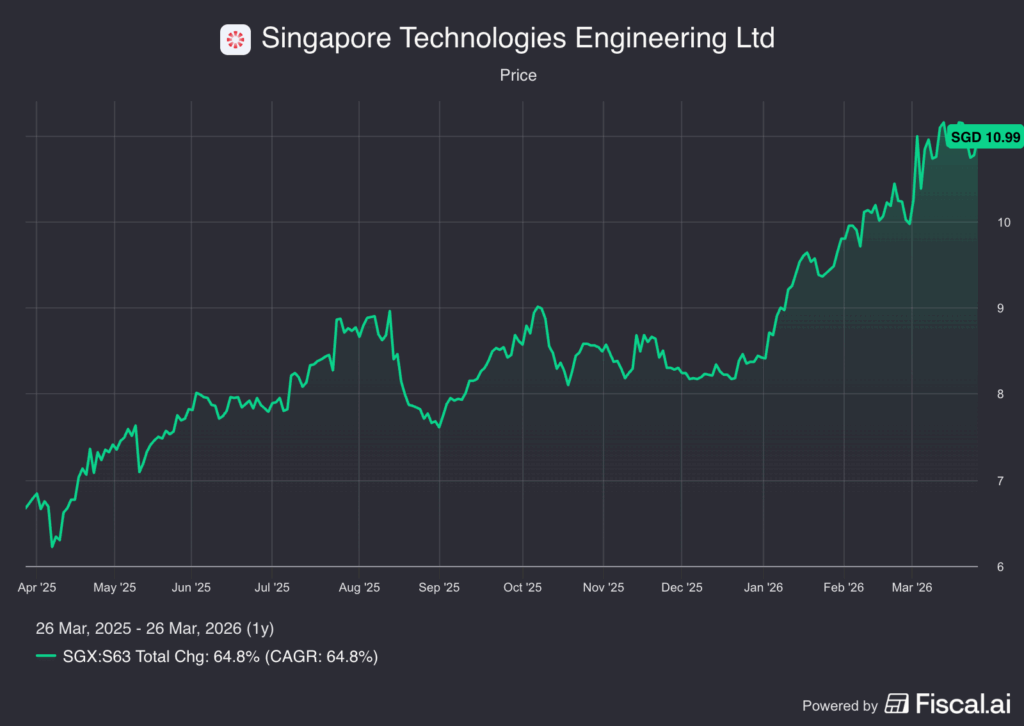
The stock has remained relatively firm even amid recent geopolitical volatility, reflecting its defensive appeal.
Industry leaders also tend to hold up better during periods of economic stress.
Parkway Life REIT (SGX: C2PU) — The Income-Generating REIT
Several factors make Parkway Life REIT, or PLife REIT, one of the sturdiest healthcare-focused pillars for any income portfolio.
Right now, it holds 74 properties, among which are hospitals, nursing homes and healthcare facilities, spread across Singapore, Japan, and France, with a combined value of S$2.57 billion.
In FY2025, the REIT’s gross revenue jumped 7.6% YoY to S$156.3 million.
Its net property income rose 8.0% to S$147.5 million.
Unitholders saw a 2.5% bump in distribution per unit (DPU) to S$0.1529.
Although a larger unit base tempered growth, new properties in Japan and France supported overall performance.
With the current unit price at S$3.99, you’re looking at a distribution yield of about 3.8%.
But the real draw here is the solid income visibility PLife REIT offers.
Following the renewal of its master lease for three Singapore hospitals, minimum guaranteed rent is set to rise 24.3% from S$79.7 million in FY2025 to S$99.1 million in FY2026.
If you’re looking to include the steadiness of healthcare assets and reliable income growth in your portfolio, PLife REIT is definitely one to consider.
NetLink NBN Trust (SGX: CJLU) — The Essential Services Provider
When markets get rough, investors seek out essential service providers like NetLink NBN Trust to ride out the storm.
NetLink keeps Singapore running by supplying the fibre broadband infrastructure that provides more than 1.5 million residential fibre connections.
This stability is reflected in its financials. In the first nine months of the current financial year (9MFY2026), revenue rose 1.6% YoY to S$313.0 million.
EBITDA declined marginally by 0.6% to S$215.5 million.
Nonetheless, on top of steady financials, NetLink has kept up a dependable payout.
Its semi-annual DPU has risen steadily from S$0.0244 in FY2019 to S$0.0271 in the first half of FY2026 (1HFY2026).
NetLink’s earnings are underpinned by regulated infrastructure and long-term connectivity demand, providing a steady income stream across market cycles.
Essential providers tend to deliver consistent income, even when economic conditions weaken.
What Makes a Stock Truly Defensive
A truly defensive stock provides consistent earnings, solid cash flows, and reliable dividends, regardless of the overall state of the economy.
Defensive stocks have business models that generate steady demand across economic cycles.
Their stability and steady dividends also help cushion declines during downturns.
Defensive investing isn’t about rapid growth. It’s about hanging on to your money and collecting a solid income, even when the market gets rough.
Get Smart: Stability Helps You Stay Invested
As we take a step back while staying attuned to the geopolitical shifts, we need to look at the bigger picture and remind ourselves that panic selling could hurt our long-term retirement plans.
Channelling that fear into investing in defensive stocks could help us ride out market volatility.
This way, our portfolios will stay healthy as we approach and enter our golden years.
What are the stock secrets to Singapore’s “quiet millionaires?” Chances are, you’ll find at least one of their favourites in this free report. Download it now and see how these stocks could power your portfolio!
Follow us on Facebook, Instagram and Telegram for the latest investing news and analyses!
Disclosure: Joseph G. does not own shares in any of the companies mentioned.