When the broader market hits new highs, it’s tempting to assume that every stock has risen in tandem.
But that’s not always the case.
Investing at market highs is like joining the longest queue for the trendiest bubble tea in town, only to realize that a few classic, reliable stalls just around the corner are still selling the exact same quality drink for a fraction of the price.
A handful of small-cap REITs listed on the SGX continue to trade well below their net asset value (NAV), even as the Straits Times Index (SGX: ^STI) has scaled fresh peaks.
The natural question for income investors is whether the market is right to be sceptical, or if these REITs are quietly delivering the goods while trading at a discount.
Let’s look at three small-cap REITs where the price-to-book (P/B) ratio tells one story, but the dividend track record may be telling another.
United Hampshire US REIT (SGX: ODBU)
At US$0.51, United Hampshire US REIT (UHREIT) trades at just 0.7 times its book value and offers a trailing distribution yield of 8.6%.
Yet the numbers suggest this is a REIT that is gathering momentum rather than losing it.
For FY2025, distribution per unit (DPU) climbed 8.1% year on year (YoY) to US$0.0439, marking the third consecutive period of growth.
Distributable income rose 5.7% YoY to US$26.9 million, even though gross revenue and net property income (NPI) both dipped 1.7% – a decline explained by divested properties, not operational weakness.
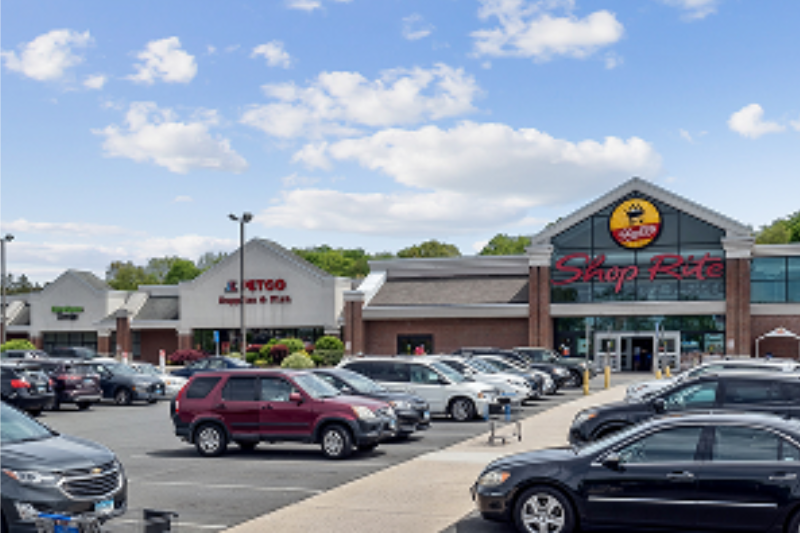
On the ground, the grocery-anchored portfolio remains incredibly resilient with a high committed occupancy of 97.7% and a long weighted average lease expiry of 7.7 years.
Most tenants are staying put, reflected in a 90% retention rate.
The manager is also proving that selling assets can lead to better returns, as the recent acquisitions of Dover Marketplace and Wallingford Fair Shopping Center each delivered a 2.0% uplift to distributions.
With aggregate leverage at a comfortable 38.6% and no debt due for refinancing until February 2028, the REIT has a reassuring runway for income investors.
It appears to be a classic case of a solid business that the market has labeled as a bargain, despite its consistent ability to put more money into the pockets of its unitholders.
Sasseur REIT (SGX: CRPU)
At S$0.66, Sasseur REIT trades at 0.82 times its book value and offers a 9.3% distribution yield – the highest among the three.
The REIT’s four outlet malls across Chongqing, Kunming, and Hefei reported a steady FY2025.
EMA rental income – which functions as both gross revenue and NPI under the REIT’s Entrusted Management Agreement model – rose 2.7% YoY to RMB 682.3 million.
DPU edged up 0.9% YoY to S$0.06138, while distributable income grew 2.8% to S$85.7 million.
The operational health of the malls is hard to ignore, with occupancy sitting at a near-full 98.8%.
What should really catch an income investor’s eye is the balance sheet.
With a gearing ratio of just 25.1%, Sasseur has one of the lightest debt loads among all Singapore REITs, giving it a massive S$867.2 million in headroom to fund future growth.
The manager has also been proactive by switching loans to RMB, which successfully lowered the cost of debt from 5.3% to 4.4%.
The trade-off? Currency risk. In Singapore dollar terms, EMA rental income actually dipped 0.2% year on year because of the weaker RMB — a drag that investors should watch closely.
Digital Core REIT (SGX: DCRU)
At US$0.52, Digital Core REIT (DCR) trades at the steepest discount of the three at 0.63 times its book value, while offering a 6.9% distribution yield.
This pure-play data centre REIT, sponsored by Digital Realty Trust, posted an eye-catching set of headline numbers for FY2025.
Gross revenue surged 72.2% YoY to US$176.2 million, while NPI climbed 43.5% to US$88.7 million.
However, there is a puzzle for investors to solve.
Despite that explosive top-line growth, DPU held flat at US$0.0360, unchanged from a year ago.
For income investors, this disconnect is a signal that while the business is expanding rapidly, the cash flow has yet to fully filter down into higher payouts.
What DCR does offer is a compelling growth runway.
Leasing momentum was strong, with US$26 million of annualised rent signed at a positive cash rental reversion of 31%.
The REIT also secured a significant 10-year lease at its Linton Hall facility in Northern Virginia at a 35% premium over the previous rent, extending its portfolio WALE from 4.6 years to 5.5 years.
With a conservative leverage of 37.1% and plenty of room to borrow for future acquisitions, this is a REIT that is building a very large engine, even if it is currently idling in terms of dividend growth.
Get Smart: Look Beyond the Discount
A price-to-book ratio below one can be an attention-grabber, but it is not, by itself, a reason to buy.
The real question for income investors is whether the dividend behind that discount is sustainable.
On that front, all three REITs have something substantial to show.
Whether it is a growing DPU, near-full occupancy rates, or a conservative approach to debt, these businesses are proving their resilience.
The risks are certainly real – ranging from currency headwinds to the temporary gap between revenue growth and distributions – but for now, the cash flows supporting these discounts remain intact.
For those willing to look past the market noise, these three small-cap players suggest that sometimes the best value is found exactly where the crowd isn’t looking.
What if you could collect a steady income from Singapore companies for decades to come? We found one in a near-duopoly with 70%+ market share that’s practically printing money. Our FREE small-cap report uncovers this “hidden monopoly” advantage (plus 4 other dividend powerhouses) that will keep paying no matter what the market does. Click here to grab your copy now.
Follow us on Facebook, Instagram and Telegram for the latest investing news and analyses!
Disclosure: Calvina L. does not own any of the stocks mentioned. Chin Hui Leong contributed to the article and does not own any of the stocks mentioned.