Several Singapore-listed stocks are hitting fresh highs on the back of strong earnings, improving fundamentals, or renewed investor confidence.
But buying at new highs can feel risky.
Investors worry about overpaying or buying too late.
We examine three Singapore stocks that have recently hit new highs, and assess whether they remain attractive buys.
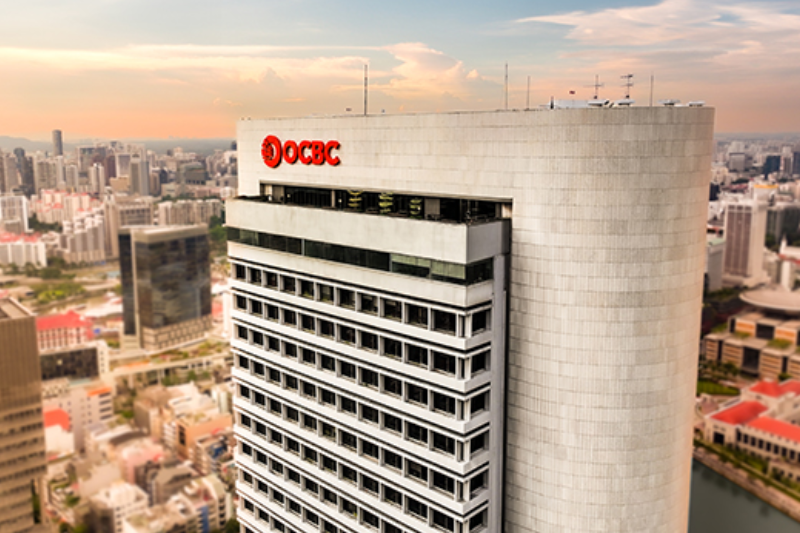
OCBC (SGX: O39)
Oversea-Chinese Banking Corporation, or OCBC, has seen an upward trend of its share prices recently, moving towards a 52-week high of S$18.80, and trading between S$18.12 and S$18.30 in late November 2025.
As one of Singapore’s big three banks, OCBC’s diverse operations across retail, corporate banking and wealth management have provided support to its steady performance even as interest margins show signs of compression.
The bank reported S$1.98 billion in 3Q2025 net profit, unchanged year on year (YoY), while net profit for the first 9 months of 2025 stood at S$5.68 billion, down 4% from the prior year.
Net interest margin (NIM) fell to 1.84% for the quarter (9M average of about 1.93%), reflecting ongoing margin pressures as interest rates stabilise.
Offsetting some of this, non-interest income exceeded expectations, supported by better-than-expected net interest income (NII) and strong non-interest income from wealth-management inflows and contributions from its insurance arm Great Eastern.
Investors continue to enjoy the strong dividends, with the 1H2025 interim payout of S$0.41 per share translating into an annualised yield of 4.5%.
The balance sheet remains solid, with a low non-performing loan ratio of around 0.9% and strong CET1 capital levels.
However, the NIM could continue to moderate into a declining interest rate environment, and earnings normalisation might occur after the strong growth seen over the last few years.
OCBC represents an attractive combination of income and stability.
The diversified business lines, its strong balance sheet and steady dividends make it an attractive investment for those income-focused investors.
However, for those investors focused on profit growth, the trajectory of interest margins will be essential.
iFast Corporation (SGX: AIY)
iFAST Corporation, a leading wealth-management fintech platform with operations across Singapore, Hong Kong and Malaysia, has been pushing toward its 52-week high of S$9.99, trading around S$9.00 in late November 2025.
The stock’s strong performance is underpinned by surging assets under administration (AUA) and recurring fee income, alongside strategic growth initiatives such as the Hong Kong eMPF rollout and digital banking expansion.
The 3Q2025 results reflected robust growth, with gross revenue reaching S$135.82 million (up 37% YoY) and net profit at S$26.01 million (up 54.7% YoY).
For 9M2025, net profit totalled S$67.15 million, up 41.8% YoY.
AUA grew 29.6% YoY to S$30.62 billion as of 30 September 2025, supported by strong net inflows and the turnaround of iFAST Global Bank, which achieved its fourth consecutive quarter of profitability in 3Q2025.
Investors continue to see returns, though modest relative to share price, with interim dividends throughout 2025 bringing year-to-date payouts to S$0.059 and implying a yield of approximately 0.7%.
The company has guided for FY2025 dividends of at least S$0.082 per share.
iFAST’s balance sheet remains healthy, with a net-cash position and strong capital and liquidity ratios at iFAST Global Bank, well above regulatory minima.
The 3Q2025 revenue and profit beat, underpinned by Hong Kong ePension, platform fees, and iFAST Global Bank profitability, boosted investor confidence as analysts raised forecasts post-results.
iFAST offers high-growth potential in digital wealth management, underpinned by a scalable business model and strong secular tailwinds.
However, investors should be aware of execution risks for new initiatives such as eMPF, regulatory considerations, and the premium valuation.
The stock is suitable for growth-oriented investors who can tolerate some volatility while capitalising on the fintech’s expansion trajectory.
SBS Transit (SGX: S61)
SBS Transit has seen its share price rise toward S$3.17 in late November 2025, not far from its 52-week high of S$3.40 reached in September 2025.
Recovery in ridership after the pandemic and improvement in operating margins, together with stable revenue visibility pursuant to the government contract model, boosted investor confidence.
Singapore’s dominant public transport operator reported 1H2025 revenue of S$745.9 million, down 4.5% YoY, while net profit was S$31.1 million, declining 7.7% YoY.
Average daily ridership on the rail network has continued its upward trend.
The North East Line saw a 2.4% increase to 593,000 passenger trips.
The Downtown Line also edged up 1.0% to 463,000 trips, and the Sengkang Punggol LRT climbed to 157,000 trips.
Commercial revenue increased 11.9% YoY in 1H2025, although bus revenue was weighed down by the loss of the Jurong West bus package.
The company also lost the Tampines Bus Package tender in September 2025, with the handover scheduled for July 2026.
This represents a further headwind for bus operations revenue.
The investment case offers stable income for investors.
The 1H2025 interim dividend of S$0.0895 per share implies an annualised yield of approximately 5% to 6%, supported by the company’s net-cash position of S$340.8 million as of 30 June 2025.
SBS Transit represents a low-volatility investment with an income focus.
The stability of cash flow and consistency in dividends underpin its appeal as a defensive investment, together with the upside from ridership recovery.
Risks include increasing manpower and energy costs, capped regulated returns, and recent losses on bus packages; growth is modest, but predictability is high.
What New Highs Really Mean for Investors
A stock hitting a new high is often a sign of strength, not necessarily overvaluation.
In long-term uptrends, stocks can reach multiple new highs as businesses expand, margins improve, and earnings compound.
Instead of focusing solely on price, investors should pay attention to the fundamentals, such as revenue growth, profitability, dividend consistency, and operational efficiency.
A key question for long-term investors: is the company getting better and creating sustainable value?
A rising stock price can be a reflection of investor confidence in a well-executing business, and staying invested through these uptrends often rewards those who look beyond the short-term noise in the markets.
Get Smart: Focus on Quality, Not Price
Across the three Singapore stocks, OCBC continues to deliver resilient earnings and stable dividends, appealing to income-focused investors.
Meanwhile, iFAST stands out for its high-growth potential, though its premium valuation calls for careful consideration.
On the other hand, SBS Transit provides dependable, defensive income, underpinned by steady ridership and government-backed contracts.
Buying at new highs is not automatically risky.
What truly matters is the quality of the underlying business and its ability to sustain and grow earnings over time.
One Singapore bank has quietly become one of the strongest income engines in the market. Its dividends have grown at 16.6% a year while others were pulling back. That level of consistency can change a retirement plan entirely. Our FREE 2026 Dividend Game Plan explains why this bank keeps lifting payouts and why many long-term investors rely on it for stable income. Download your free copy today.
Follow us on Facebook, Instagram and Telegram for the latest investing news and analyses!
Disclosure: Darien does not own any of the shares mentioned.