A main gripe for dividend investors in Singapore is that most companies elect for semi-annual payments: one interim dividend and one final dividend.
Having just two dividend payments a year can make your income feel lumpy, which is why receiving quarterly dividends is sometimes more attractive to income-focused investors and retirees as cash comes into your bank account on a more regular basis.
This increased access to dividend payments facilitates budget planning and the ability to more consistently reinvest dividends throughout the year, creating a more seamless passive income experience.
Having established that, what other factors make quarterly dividend stocks more appealing?
In a word, reliability.
We want companies that have proven track records of maintaining or increasing payouts, funded by resilient income and cash flows.
Having a strong balance sheet with low leverage is also key.
Sustainability of a dividend is equally, if not more, important than the frequency of payout.
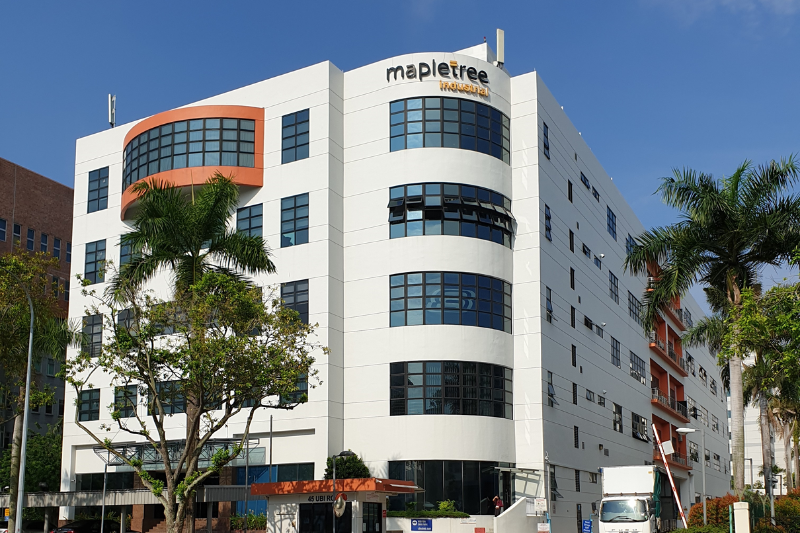
Mapletree Industrial Trust (SGX: ME8U), or MIT — The REIT Income Anchor
This industrial REIT powerhouse stands out with its portfolio of properties in the following segments: data centres (58.3%), hi-tech buildings and business space (18.1%), and general industrial buildings (23.6%).
With over 136 properties spread across North America, Singapore, and Japan, the REIT enjoys stable rental income from a wide range of reputable clients across different industries.
MIT’s steady income has allowed the REIT to pay a regular quarterly dividend, stretching back to 2010.
For the third quarter of the financial year ending 31 March 2026 (3QFY2026), distribution per unit (DPU) came in at S$0.0317, representing a 7.0% decline compared to a year ago.
Excluding the one-off divestment gain distributed in the prior year period, DPU declined 3.9% year on year (YoY).
Currently, the industrial specialist offers a trailing annual distribution yield of 6.6%.
Overall occupancy for MIT is high, at 91.4% as of 31 December 2025.
Despite recent DPU fluctuations, the fundamental strength of MIT’s industrial portfolio and its long history of quarterly payouts solidify its position as a cornerstone for any dividend-focused portfolio.
Riverstone Holdings Limited (SGX: AP4) — The Defensive Dividend Compounder
Riverstone provides high-quality gloves and related consumables/equipment for healthcare, food, and cleanroom purposes.
Given the resilient nature of this business (the need for hygiene persists even in an economic downturn), the group has produced consistent positive annual free cash flow over the last 10 years.
Riverstone balances the cash it generates between reinvesting in the business and rewarding shareholders with a regular annual dividend paid quarterly.
The group stands out, having paid a consistent annual dividend stretching back to 2006, supported by stable net earnings (normalising for the 2020-2022 pandemic spikes).
Furthermore, Riverstone carries zero debt on its balance sheet, with a cash position of RM630.4 million as of 31 December 2025.
Despite facing year-on-year headwinds, the group reported its third consecutive quarter of profit growth as its net profit for the fourth quarter ended 31 December 2025 (4QFY2025) rose 3.7% sequentially to RM54.0 million.
This was underpinned by robust AI-driven demand in the cleanroom segment and a strategic shift towards high-margin customised products that are expected to drive further volume growth and margin normalisation through 2026.
DBS Group Holdings (SGX: D05), or DBS — The Growth Plus Income Play
Finally, the last name on this list is probably everyone’s favourite dividend payer: DBS.
This bank stands out for its strong quarterly dividends and the potential for decent capital appreciation.
Both the top line and the bottom line have seen decent growth over the last few years, aided by a period of elevated interest rates that lifted the bank’s net interest margin.
While rates fell sharply in 2025, DBS managed to grow net interest income to a record S$14.5 billion through proactive balance sheet hedging.
In FY2025, the bank declared a total dividend of S$3.06 per share, comprising S$2.46 in ordinary dividends and S$0.60 in capital return dividends, representing a 38% increase YoY.
The capital return dividend is expected to be maintained for FY2026 and FY2027 barring unforeseen circumstances.
The bank’s dividend sustainability is further supported by its strong capital buffers, with a common equity tier 1 (CET1) ratio of 15.0%, giving DBS some breathing room to support dividend payments even when the going gets tough.
Should DBS continue to execute well and grow its non-interest segments, the bank could also see some decent capital appreciation in its share price.
The key takeaway is that you don’t have to sacrifice growth for quarterly dividend payments.
Get Smart: A Good Dividend Is Better Than a Frequent One
In conclusion, quarterly dividends are appealing because they provide more regular income, enabling better expense management and reinvestment opportunities.
However, they are only as valuable as they are reliable.
Investors must look beyond the headline yield to assess dividend sustainability (is the payout sufficiently covered by cash flows?), balance sheet strength and the dividend track record during hard times.
After all, the best defence for an income portfolio isn’t the frequency, but the resilience of the payout.
When the market is unpredictable, where can you park your money with confidence? Our latest FREE report reveals 5 Singapore dividend-payers built to withstand global storms. Get it now and see what’s still worth holding.
Follow us on Facebook, Instagram and Telegram for the latest investing news and analyses!
Disclosure: Wilson H. does not own shares in any of the companies mentioned.